


How Do Explosion-Proof Motors Achieve Explosion Protection in Dust Environments?
Apr 10, 2026
Leave a message
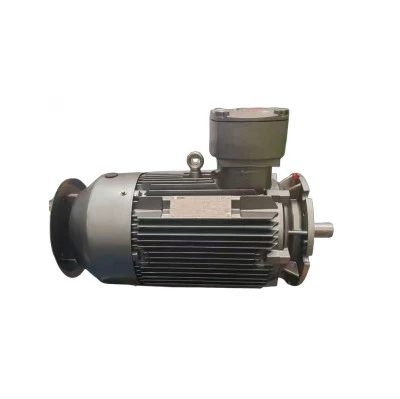
Dust explosion-proof motors are specially designed for environments with combustible dust. The core principle is to prevent dust from entering and accumulating inside the motor, while ensuring the motor surface temperature does not reach the ignition temperature of dust.
This is achieved through a fully enclosed structure, increased enclosure protection level, smooth dust-resistant surfaces, and reliable sealing design to reduce dust adhesion and ingress. Strict control is also applied to the temperature rise of the motor casing, keeping it below the minimum ignition temperature of dust, thus preventing ignition or explosion at the source.
The enclosure protection types include "ta", "tb" and "tc". The explosion-proof marking Ex ta corresponds to EPL Da (very high level of protection, not an ignition source under normal operation, expected faults or rare faults). Ex tb corresponds to EPL Db (high level of protection, not an ignition source under normal operation or expected faults). Ex tc corresponds to EPL Dc (general level of protection, not an ignition source during normal operation; additional protective measures may be used to avoid effective ignition where ignition sources are expected to occur frequently).
Such motors typically require a protection level of IP65 or higher, with tight enclosure sealing and reasonable heat dissipation to effectively block dust intrusion. They are suitable for hazardous areas with combustible dust, including Zones 20, 21 and 22, and are widely used in industries such as grain processing, feed production, wood processing, metal polishing, tobacco, and chemical powder processing. They drive equipment including conveyors, crushers, screening machines, mixers, and fans.
To further understand the structural characteristics of it, a brief comparison between gas explosion-proof and dust explosion-proof motors is provided below.
Gas explosion-proof motors are designed for explosive gas environments, mainly used in hazardous areas with flammable gases or vapors. They focus on preventing arcs, sparks and high temperatures from igniting gases. Common types include flameproof, increased safety, intrinsically safe and pressurized motors. They apply to gas explosive hazardous zones 0, 1 and 2, and are mostly used in petroleum, chemical, coal mining, natural gas and related industries.
Dust explosion-proof motors are intended for environments with combustible dust or fibers. Their core features are dust-tight sealing and surface temperature control to prevent dust from entering and accumulating inside the motor and being ignited. Their protection level is mostly IP65 or higher, suitable for dust explosive hazardous zones 20, 21 and 22. They are commonly found in grain processing, wood processing, metal polishing, feed, chemical powder and similar applications.